REVIEW · SELF-GUIDED TOURS
Washington DC Neighborhoods Personalized Self-Guided App Tour
Book on Viator →Operated by Pintours · Bookable on Viator
A smart way to read DC on foot. This Washington DC neighborhoods route pairs quick landmark stops with app narration, so you’re not just taking photos—you’re getting the story behind places like Union Station and the Library of Congress.
What I like most is the payoff for the money: it’s only $5 per group (up to 15 people), and several stops include free or included entry. I also like the pacing: you get short segments at major sites, which works well when you only have a half day.
The main thing to consider is tech. One participant ran into trouble connecting to the virtual guide and said entry into the Library of Congress required a scheduled reservation, which can turn a plan into a scramble.
In This Review
- Key Highlights at a Glance
- Why This App Tour Makes Sense in DC’s Capitol Core
- Union Station: The Burnham-Era Opening That Sets the Tone
- The Federal Judiciary Stop and Thurgood Marshall’s Capitol Hill Connection
- Obama’s Former DC Neighborhood: How “Place” Becomes a Story
- Frederick Douglass National Historic Site in a Tight Window
- Folger Shakespeare Library: Famous Stacks Without the Detour
- Florida House: The Only State Embassy in DC
- Women’s Equality Monument and the National Women’s Party Story
- Supreme Court and the United States Capitol: Where Symbols Meet Function
- Library of Congress Finale: Big Collections and a Smooth Ending
- Price and Time: Is $5 Per Group Worth It?
- How the App Tour Actually Feels: Phone Check, Connection Check, Pace Check
- Best Fit: Who Should Book This Washington DC Neighborhoods Route?
- Should You Book This Tour? My Practical Take
- FAQ
- FAQ
- How much does the Washington DC Neighborhoods Personalized Self-Guided App Tour cost?
- How long is the tour?
- What language is the tour available in?
- Where does the tour start and end?
- Does the tour include tickets for any stops?
- Is this tour private?
Key Highlights at a Glance

- Union Station’s Burnham-era design gets you started with context before you head deeper into Capitol Hill
- Thurgood Marshall context adds meaning to the federal-judiciary stop near the Capitol area
- Quick, themed stops keep the walk from feeling like a checklist
- Several Free-entry sites (like the Frederick Douglass National Historic Site and Folger Shakespeare Library) help your budget
- Capitol and Supreme Court viewpoints make the political heart of DC feel tangible
- Library of Congress as the finish line gives you a satisfying finale with included admission
Why This App Tour Makes Sense in DC’s Capitol Core

This is a self-guided, personalized app tour designed for a concentrated loop through Washington’s most story-dense blocks. The big idea is simple: you follow a walking route between landmarks, and the app provides guided narration while you’re there.
If you like control over pace, this format can feel good. You can pause, look longer, or move on without waiting on a group to catch up. And since it’s offered in English, you’re not juggling language barriers while you’re trying to read plaques and street signs.
Your tradeoff is that the experience depends on your phone. If your connection is weak or the app fails to load the narration, you lose the “guide” part of the guide. You’re still standing in front of the sights—but you’ll miss the built-in storyline that ties them together.
You can also read our reviews of more guided tours in Washington DC



Union Station: The Burnham-Era Opening That Sets the Tone
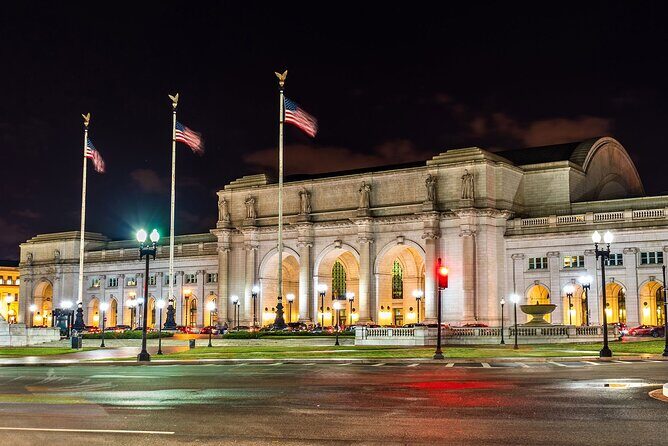
You start at Union Station (50 Massachusetts Ave NE). This isn’t just a handsome train station; it was one of America’s early great “union” terminals, and it opened in 1907. The app focuses on architect Daniel Burnham and explains how this building shaped DC’s role in the country’s movement of people and power.
Why this first stop matters: it gives you a framework for everything that follows. Union Station is where the city meets the nation. When you understand the station’s ambition, the Capitol area feels less like random government buildings and more like a carefully built national stage.
Practical tip: Union Station is a big, busy space. Before you start walking, take a quick moment to orient yourself inside, so you’re not hunting for the “next” direction while you’re trying to follow the app.
The Federal Judiciary Stop and Thurgood Marshall’s Capitol Hill Connection
From Union Station, the route brings you to the administrative headquarters of the federal judiciary. Here, the app narration centers on Thurgood Marshall—who he was and how his work connects to Capitol Hill and broader American history.
This is the kind of stop that can be easy to skip if you only read headlines. Marshall’s story is deeply tied to the legal changes that affected civil rights in the United States, so you’re not just passing a building—you’re attaching a name and timeline to what you’re seeing.
Time on the app for this segment is part of the tour’s “short and focused” approach, so don’t expect an hour-long lecture. Instead, think of it as a guided introduction that helps you notice details you might otherwise miss, like the civic seriousness of the setting.
Obama’s Former DC Neighborhood: How “Place” Becomes a Story

Next comes a themed stop about the former President Obama’s DC neighborhood. The app points out where he lived and shares stories about his time there.
Even if you’re not a political history buff, I think this part is the most human-feeling section of the tour. It reframes “Capitol Hill” into something you can picture as lived-in—not just government offices and monuments. It also helps you connect the walking route to modern DC life.
Because this is an app narration segment, pay attention to what it tells you to look for. At street-level, the built environment can look similar—so the app’s pointers are what turn the scene into a story.
Frederick Douglass National Historic Site in a Tight Window
The tour then heads to the Frederick Douglass National Historic Site. Your app guidance sets the tone with the former home of Douglass, plus his connection with President US Grant, and more.
This stop is allocated about 15 minutes, and that’s realistic. It’s a site you can enjoy quickly if you focus on the main themes rather than trying to read every word in depth. If you want extra time, you can always break away after your app segment ends.
This is also one of the free-entry points on the route. For many visitors, that combination—meaningful content plus no paid admission—makes it a smart use of a limited schedule.
You can also read our reviews of more tours and experiences in Washington DC






Folger Shakespeare Library: Famous Stacks Without the Detour

Next is the Folger Shakespeare Library, described as the world’s largest Shakespeare library. The app explains why it matters on Capitol Hill and highlights Shakespeare-related facts.
If you’ve ever felt that DC museums can be either too broad or too heavy, this is a nice middle path. It’s culture in a political neighborhood. You get to see a different side of the city’s institutions—one where literary history sits alongside civic power.
This segment is about 20 minutes, so focus on what you can see without turning it into an all-day museum project. When an app tour gives you a short window, it usually works best when you keep your expectations aligned with a brisk visit.
Florida House: The Only State Embassy in DC
The Florida House stop is one of the more unusual stops on the route: it’s described as the only state embassy in DC. The app explains why it exists and how it functions today, with some extra benefits if you’re coming from Florida.
This is a great “pattern breaker.” Most DC tours focus only on federal symbols. Florida House reminds you that states also show up in the city’s official landscape—even if it’s not always obvious from the street.
If you’re not from Florida, you’ll still get the value: it’s a lesson in how government and representation work at multiple levels. And because the tour gives it about 20 minutes, you can enjoy it without losing momentum toward the Capitol.
Women’s Equality Monument and the National Women’s Party Story

The next stop is the Belmont Paul Women’s Equality Monument, maintained by the National Park Service. The app frames it as the headquarters of the National Women’s Party and connects it to the suffragists’ struggle to win the vote.
This is the kind of stop that can feel small until you understand the stakes. Once you connect it to the organizing and activism behind suffrage, the monument becomes more than statuary. It becomes evidence of a campaign that changed American life.
I like that the tour doesn’t treat this as a standalone “women’s rights” point. It feeds into the larger theme of who gets to participate in democracy, which ties naturally to what you’ll see later at the Supreme Court and the Capitol.
Supreme Court and the United States Capitol: Where Symbols Meet Function
After the equality monument, you’ll move into the classic DC power-and-law zone. The app includes a stop at the Supreme Court, explaining the history behind the court and how it functions today.
Then it takes you to see the United States Capitol and talk about the building’s architecture and famous speeches held there.
This is where the route really earns its name: Washington DC neighborhoods is a story idea, but the Capitol area is the visual anchor. The app helps you read what you’re looking at. Without that context, it’s easy to see these buildings as only impressive backdrops. With the context, you get a sense of the system behind the stones.
One practical note: crowds can slow you down around major landmarks. If your phone battery is low, this is the time to make sure you’re protected, because you’ll want the narration while you’re standing there.
Library of Congress Finale: Big Collections and a Smooth Ending
The tour ends at the Library of Congress (101 Independence Ave SE), inside the building. This is the final stop and the app gives you about 45 minutes, with admission included.
The Library of Congress is introduced as the world’s largest library, and the app aims to help you understand its background and the kind of treasures you can find inside. This is a strong finale because it flips the usual “politics only” expectation. In DC, the government buildings get the headlines, but the Library of Congress represents the record-keeping, knowledge, and archives side of national life.
That said, here’s the key caution based on a reported issue: one participant said they were not told ahead of time about needing a reserved time for Library of Congress entry, and they couldn’t get in without that reservation. If you want to avoid stress at the finish, I’d plan to check entry requirements ahead of time and not rely on last-minute fixes.
If your group likes a calm ending, this stop can give you that. If you want maximum flexibility, just assume you may need to manage timing.
Price and Time: Is $5 Per Group Worth It?
At $5 per group (up to 15 people), the pricing is hard to beat. The value here isn’t that you’re paying for a high-end guided escort. It’s that you’re paying for an organized walking story that strings together major sites across the Capitol area.
The duration is listed as about 2 to 4 hours, which is a sweet spot for many visitors. It gives you time to cover the core landmarks without committing to a full day. It also means you can pair this with your own choices afterward—dinner, a neighborhood walk, or another museum detour.
What you should weigh is risk vs. reward:
- Low cost makes a tech hiccup easier to tolerate.
- But because it’s app-led, tech problems hit the “guide” layer directly, not just optional extras.
If you have a reliable phone setup and comfortable walking pace, this is a very budget-friendly way to get narrative context around big-name DC stops.
How the App Tour Actually Feels: Phone Check, Connection Check, Pace Check
This is the part where I’d be most honest with you. A self-guided app tour can be fantastic when everything loads quickly. But when it fails, you can end up standing with your sights in front of you and no narration to connect the dots.
One participant described a situation where the virtual guide wouldn’t continue after an intro, and their attempts to reconnect didn’t work. They also reported a problem connecting to their music library when prompted. The end result was frustration and extra time spent figuring out alternatives on the spot.
You don’t need to panic, but you should prepare:
- Start with a fully charged phone.
- Confirm you have cellular or Wi‑Fi where you’ll begin (Union Station can be hit-or-miss depending on your signal).
- Bring a basic backup plan in case narration doesn’t load—like saving directions offline and knowing the next landmark name.
Also, if you’re planning to finish inside the Library of Congress, treat timed-entry needs seriously. Even when admission is free, you may still need a reserved slot.
Best Fit: Who Should Book This Washington DC Neighborhoods Route?
This tour is a good match for you if:
- You like DC landmarks but prefer a guided story without a live group pacing you.
- You’re comfortable using an app and want a structured route from Union Station to the Library of Congress.
- Your group includes a range of ages or interests, because the route mixes civic power, civil rights, culture, and women’s suffrage themes.
It might be less ideal if:
- You know you struggle with app connectivity in public spaces.
- You don’t want to handle troubleshooting if narration doesn’t load.
- You strongly prefer a guaranteed “entry happens when the tour starts” experience, especially for the Library of Congress.
For seniors or anyone who might be less patient with tech fixes on busy sidewalks and big indoor venues, I’d recommend planning extra buffer time.
Should You Book This Tour? My Practical Take
If your goal is to get a lot of Capitol Hill context in a half day without spending much, this tour looks like a strong deal. The route hits iconic places—Union Station, Supreme Court, Capitol, Library of Congress—while also including more focused story stops like Thurgood Marshall and the National Women’s Party.
My main “maybe” is the app reliability and the finish at the Library of Congress. If you’re the type who panics when a phone won’t cooperate, you may end up spending your energy troubleshooting instead of enjoying the scenery and stories.
Still, with smart preparation—charged phone, offline maps, and a check on entry expectations for the final stop—this can be an efficient, meaningful way to understand Washington DC neighborhoods from the inside of the story.
FAQ
FAQ
How much does the Washington DC Neighborhoods Personalized Self-Guided App Tour cost?
It costs $5.00 per group, and the group size can be up to 15 people.
How long is the tour?
The tour takes about 2 to 4 hours.
What language is the tour available in?
The tour is offered in English.
Where does the tour start and end?
It starts at Washington Union Station, 50 Massachusetts Ave NE, Washington, DC 20002, and ends inside the Library of Congress at 101 Independence Ave SE, Washington, DC 20540.
Does the tour include tickets for any stops?
Yes. Union Station and the Library of Congress include admission tickets, while other listed stops include free admission.
Is this tour private?
Yes. It is a private tour/activity, and only your group will participate.