REVIEW · SCOOTER RENTALS
Scooter Tour — Washington DC’s Monuments and Memorials
Book on Viator →Operated by Adventure DC Tricycle Tours · Bookable on Viator
DC monuments look different when you glide from place to place. This private scooter tour threads together the city’s biggest stops fast, with a guide who narrates so you’re not just looking at buildings and hoping for the best.
I especially like the way you get serious time-saving on foot traffic, lines, and long distances between memorial clusters. It’s a great match for families who want to keep energy up without turning the trip into a marathon.
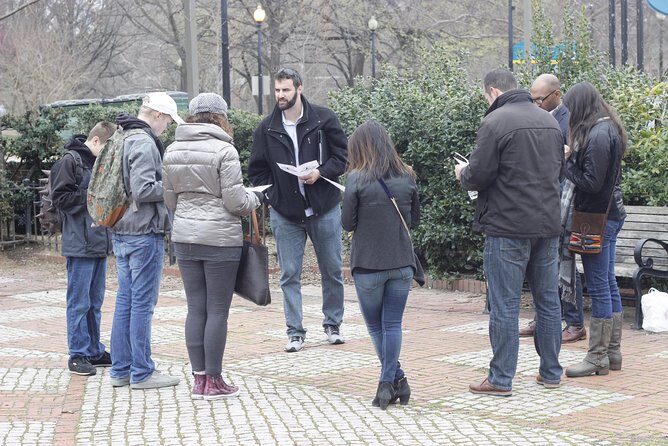
The second big win is the guide-and-group setup: pickup is offered, the tour is private (your group only), and the guide keeps things organized so you’re ready when it’s time to move. One possible drawback: this experience requires good weather, and because you’re on a scooter, rain, high winds, or slick sidewalks can affect comfort and timing.
In This Review
- Key things that make this Washington DC scooter tour work
- Price and what your $540 per group really buys
- Meeting at 1012 14th St NW: getting started without chaos
- White House to Treasury: the best first-look photos, fast
- The Willard Hotel, Pershing Park, and WWI’s emotional arc
- Smithsonian landmarks you can plan around (even if you won’t enter)
- Washington Monument and the Holocaust Memorial: two different kinds of weight
- The practical DC stop: Bureau of Engraving and Printing
- Tidal Basin season context: Jefferson and George Mason
- From across the Potomac: the Pentagon and the big-systems viewpoint
- Franklin Delano Roosevelt to MLK Jr.: leadership memorials that hit differently
- Korean War, Lincoln, and Vietnam: the emotional center of the route
- WWII, the Declaration signers, and other “lesser-known but meaningful” stops
- Beyond the Mall: Arlington, National Archives, and the museum row
- Quick highlights that often surprise people
- What to bring for a smoother scooter day
- Should you book this Washington DC monuments and memorials scooter tour?
- FAQ
- How long is the scooter tour?
- How much does the tour cost?
- Is this a private tour?
- Where do we meet?
- Do you offer pickup?
- Who can participate (age limits)?
- Can children ride with an adult?
- Are service animals allowed?
- What happens if weather is bad?
- Is cancellation free?
Key things that make this Washington DC scooter tour work

- Private group of up to 6 means you’re not squeezed into a crowd during photo stops.
- Narration that connects the dots helps monuments feel like a story, not a checklist.
- A 3-hour plan with short stops is ideal if you want maximum sights without hours of walking.
- Pickup offered cuts the stress of getting everyone to the right spot.
- Family-friendly scooter options can keep kids engaged, including guidance shared by guides like Fahad.
- Small-pet allowance with a proper backpack is a thoughtful touch for travelers who don’t want to leave pets behind.
Price and what your $540 per group really buys
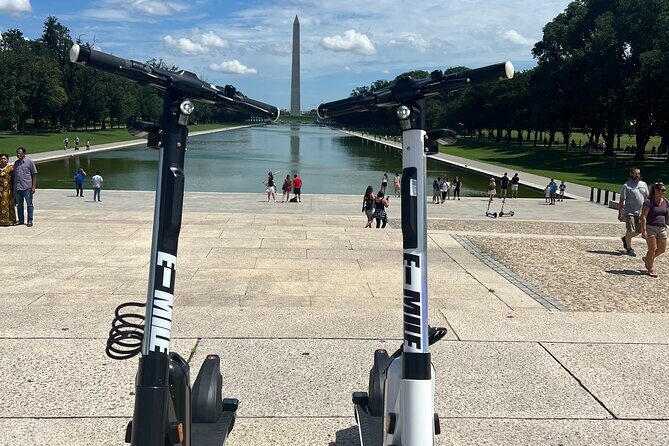
At $540 per group (up to 6 people), this is best value when you fill the group. If you book as a full party, you’re effectively splitting the cost among friends or family and getting a guided DC “greatest hits” route in about 3 hours. If you’re booking just for 2, it’s still doable, but the per-person price feels higher—so it’s a smarter buy for groups or multigenerational families.
The tour’s format matters for value. You’re not paying only for a ride; you’re paying for a plan that compresses the National Mall and major memorial neighborhoods into one guided loop. That saves you from juggling transit, parking, and “How do we get from this monument to the next?” logistics—especially when time is tight.
You can also read our reviews of more tours and experiences in Washington DC



Meeting at 1012 14th St NW: getting started without chaos
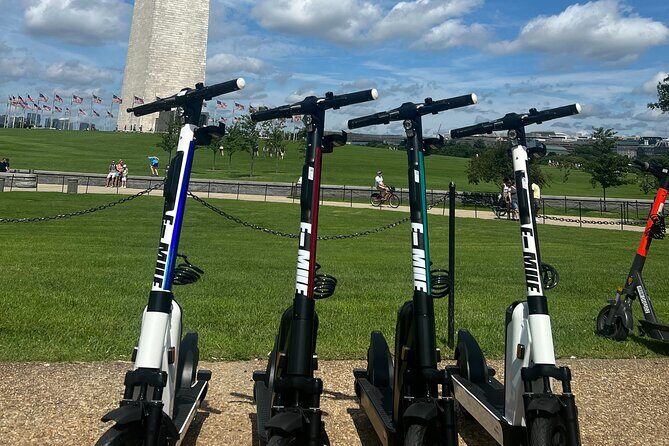
The tour begins at 1012 14th St NW, Washington, DC 20005, and it ends back at the meeting point. If you’re offered pickup, that’s a real convenience on a city day when you’d rather spend minutes sightseeing than coordinating routes.
A mobile ticket is included, which helps you avoid paper-print stress. And because the route is designed for scooters, you won’t need to figure out long blocks of walking just to see the major icons.
White House to Treasury: the best first-look photos, fast
You start at the White House viewing area near Lafayette Square. Even from outside the secure perimeter, the north-side perspective is dramatic: grand columns, white façade, and the sense of being right next to a place that has hosted generations of presidential moments.
Next, you pause by the United States Department of the Treasury area to see the Hamilton Statue. Alexander Hamilton’s story shows up here in bronze form—he’s depicted holding a book and a scroll, tying the monument to his role as a founding financial mind. It’s a quick stop, but it gives you context for why American money and national identity are linked in DC’s architecture and symbolism.
Then comes the William Tecumseh Sherman Monument (bronze, designed by Augustus Saint-Gaudens, dedicated in 1903). This stop is a good example of why a guide helps: you don’t just see a statue—you understand the Civil War legacy it represents.
Practical note: These early stops are short. If your goal is a super-slow photo session, plan to do extra photos before or after the tour. During the ride, think “capture the key angles” rather than “wait for the perfect light.”
The Willard Hotel, Pershing Park, and WWI’s emotional arc
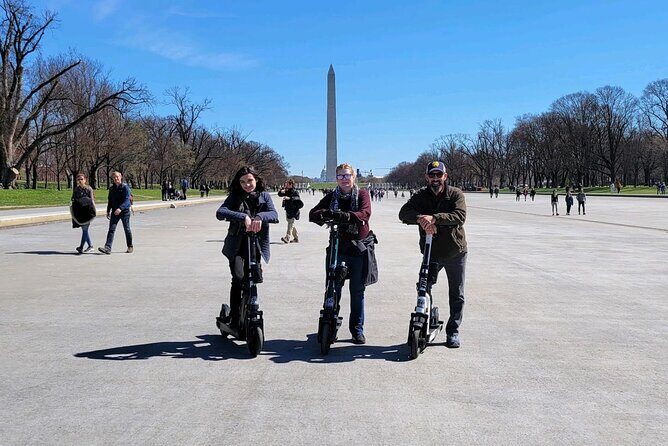
A standout stop on this route is the InterContinental the Willard Washington D.C. by IHG, with its deep political and communications history dating back to the mid-1800s. You also get a sense of how DC’s power centers operated—hotels like this weren’t just where people stayed; they were where decisions were made.
From there, you move to the National World War I Memorial in Pershing Park. The central design, A Soldier’s Journey, tells a multi-step story: leaving family, facing combat, enduring loss, and returning home after medical care. It’s the kind of memorial that lands harder when you know what the imagery is trying to say.
If you’re traveling with kids, this is a smart point in the day. The guide’s narration helps turn “stone and plaques” into a sequence. That keeps attention from drifting.
Smithsonian landmarks you can plan around (even if you won’t enter)
The route also includes major Smithsonian-adjacent stops where you’ll get a look at big-picture DC institutions without needing to spend your whole day inside museums. On this ride, you’ll see the U.S. Department of Commerce Building (completed in 1932, with an enormous footprint and many windows—details like that make you realize how much government space sits right in the middle of tourism).
You’ll also get stops connected to the Smithsonian story:
- National Museum of African American History and Culture: artifacts and exhibits that document African American life, history, and culture.
- The Smithsonian Castle: the administrative center and a symbol of the Smithsonian Institution.
And along the National Mall and nearby corridors, you’re routed past some other heavy hitters in the museum universe (based on what’s on the stop list). These can be perfect for planning what you’ll do later if you want deeper time—because the tour can only give you a quick orientation.
Consideration: If you’re the type who expects to walk through multiple museums during a 3-hour scooter tour, temper expectations. This is a look-and-learn format.





Washington Monument and the Holocaust Memorial: two different kinds of weight
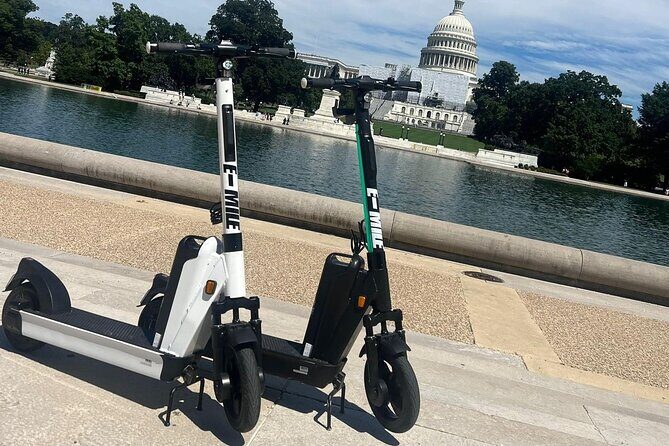
The Washington Monument is an essential stop: it’s dedicated to George Washington and rises to 555 feet 5 1/8 inches. Seeing it from the proper vantage matters, and a guide helps you orient yourself quickly so you understand where it sits in the larger ceremonial geography of the city.
Then you move to the United States Holocaust Memorial Museum (USHMM). This is not a “fun stop,” and the tour treats it that way—focused on remembering victims and survivors and urging people to confront hatred and prevent genocide. Even without long indoor time, it’s a moment that gives the day meaning.
The practical DC stop: Bureau of Engraving and Printing
A nice balance on this route is the Bureau of Engraving and Printing, where U.S. paper money is made and other security documents (including passports and visas) are printed. Seeing a government production site on a monuments tour adds a useful “how the country runs” layer.
This stop works well for families because it’s concrete. It’s not just about history; it’s about the present-day system behind everyday life.
Tidal Basin season context: Jefferson and George Mason
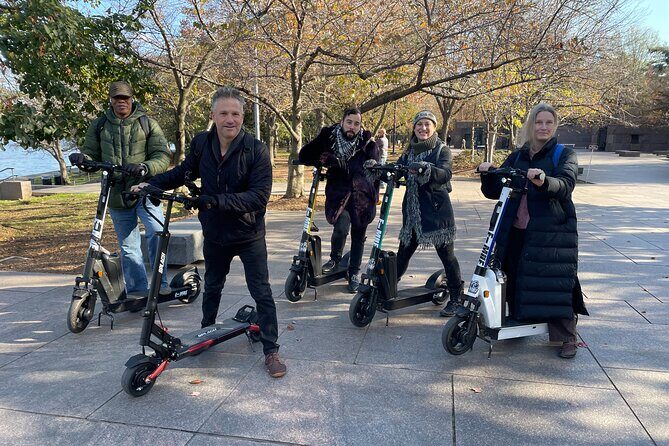
The tour swings by the Tidal Basin, a man-made basin tied to the Potomac River’s tides and famously associated with cherry blossoms each spring. Even if you’re not visiting during peak bloom, it’s a great way to understand DC’s seasonal rhythms.
Next up is the Thomas Jefferson Memorial (built 1939–1943). Jefferson’s quotes on the interior emphasize his political philosophy and Jeffersonian democracy. Neoclassical style makes it visually easy to take in quickly, and the guide’s narration helps you connect the design with the message.
You also see the George Mason Memorial, near the Tidal Basin and the National Mall area. Mason’s story is connected to founding-era ideas, so this stop complements Jefferson by expanding who gets remembered—and why.
From across the Potomac: the Pentagon and the big-systems viewpoint
You’ll also get a viewpoint stop for the Pentagon, seen from across the Potomac River. The iconic five-sided rings are instantly recognizable, and it’s a useful contrast to the civic memorial energy of the Mall: here, the focus shifts toward defense and national security architecture.
This part of the tour is less about “read every plaque” and more about getting your bearings fast around a place that’s culturally famous and visually unique.
Franklin Delano Roosevelt to MLK Jr.: leadership memorials that hit differently
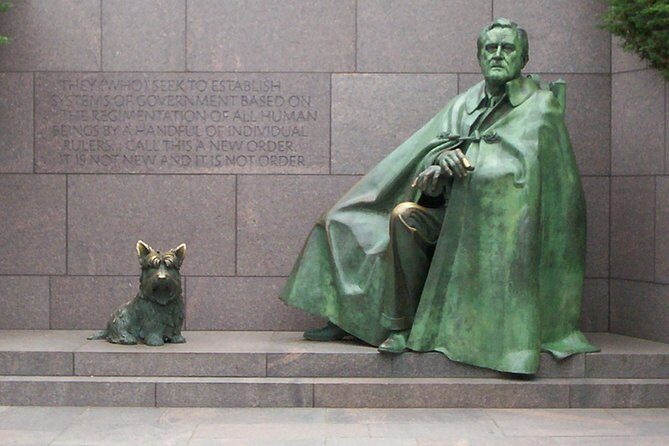
A major stop here is the Franklin Delano Roosevelt Memorial at 1850 West Basin Dr SW. You get a longer pause (about 15 minutes in the plan), which signals that the guide expects you to sit with it a bit. It’s a chance to read the theme of the era it represents and see how memorial design can summarize leadership through time.
Then you pause near the Martin Luther King Jr. Memorial Bookstore. The MLK memorial area honors his legacy in the modern civil rights movement—freedom, equality, justice, and advocacy for racial equality and the oppressed.
This is also where narration becomes key. MLK’s legacy is widely known, but the memorial’s role in connecting values to physical space is something you’ll get more clearly with a guide-led stop.
Korean War, Lincoln, and Vietnam: the emotional center of the route
The Korean War Veterans Memorial is next, with a text focus on defending a country and people many of the service members never knew. It’s a short but respectful stop.
Then comes one of the biggest anchors: the Lincoln Memorial. Plan for around 15 minutes here. Lincoln’s presence in marble—paired with the setting in the Mall’s wide-open ceremonial layout—makes this stop feel like a civic moment. The guide helps you understand the memorial’s language and symbolism without turning it into a rushed reading contest.
After Lincoln, the tour hits Vietnam-era remembrance:
- The Three Servicemen Statue (bronze, representing different military branches).
- Vietnam Veterans Memorial, with its two black granite walls and names of more than 58,000 Americans who died or remain missing, plus a bronze soldiers statue and a flagpole.
This portion is emotionally heavy, so the scooter format is a gift. You get to move efficiently between stops while still having time to stand and look. If you’re easily overwhelmed, consider doing a few deep breaths before you approach the wall.
WWII, the Declaration signers, and other “lesser-known but meaningful” stops
The route continues with the World War II Memorial (stone architecture and bronze sculptures recognizing service, the fallen, and the victory achieved). It pairs well with the Vietnam memorial stops because together they show how different wars are remembered differently in DC design.
You’ll also encounter the 56 Signers of the Declaration of Independence Memorial in Constitution Gardens. This is the “founding courage” angle: stone markers include signature facsimiles plus home locations and occupations. It’s a smaller stop, but it gives a tangible sense of risk and consequence.
Other military and historical stops on the ride include:
- John Paul Jones Memorial, tied to his Revolutionary War naval hero story and his famous line about not having begun to fight.
- Peace Monument, honoring Civil War-era sacrifices with symbolic imagery of reconciliation and hope.
- A handful of Civil War and leadership memorials nearby that help map how DC spreads remembrance across many eras.
Why I like this mix: It keeps the day from being only one emotional register. War remembrance in DC is powerful, but it’s also layered—so you leave with a broader map of what the city chooses to memorialize.
Beyond the Mall: Arlington, National Archives, and the museum row
The itinerary doesn’t stop at the Mall. It includes major Northern Virginia remembrance stops in the broader DC orbit:
- Arlington House (Robert E. Lee Memorial), with garden views and the sense of layered American history.
- Arlington National Cemetery, where you can see the solemn white headstones, the Changing of the Guard at the Tomb of the Unknown Soldier, and overlook-style views. (Your ride provides the orientation; you may still choose to return later.)
- Air Force Memorial, with three spires and panoramic views toward the Pentagon and DC.
Back on the DC side, the route includes stops that shift the day toward documents, crime, media, and culture:
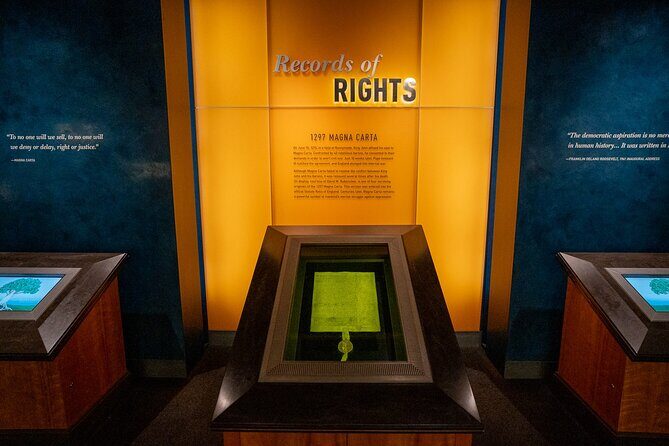
- National Archives Museum, including the Declaration of Independence, Constitution, and Bill of Rights in its famous Rotunda.
- FBI Headquarters, known for its Brutalist architecture and modernist design with exhibits focused on history and mission.
- The Newseum, focused on the power and importance of free press through interactive, newsroom-style experiences.
You’ll also have points on the route for major art and nature institutions, including:
- National Gallery of Art
- Hirshhorn Museum of Art
- Smithsonian National Museum of Natural History
- Smithsonian Arts + Industries Building
- National Museum of the American Indian
- United States Botanic Garden
- Smithsonian National Air and Space Museum
- US Department of Agriculture (USDA) for agriculture, nutrition, and food safety learning
Even if you don’t enter on this tour, the quick stops help you decide what to prioritize later.
Quick highlights that often surprise people
A few route elements tend to feel like curveballs in the best way:
- Einstein Memorial in an elm and holly grove, tied to the Academy grounds and his centennial recognition.
- World War I and World War II memorial sequencing, which shows how DC’s memorial language changes by conflict.
- Bureau of Engraving and Printing, which connects national identity to how money and secure documents are made.
And there’s a human factor. In the best-guided versions of this tour, guides like Fahad are noted for being patient with kids—one family highlight included suggestions for a sit-down scooter option for their daughter—and for pitching ideas on where to eat right after the ride. Another guide, Barry, is praised for being organized and easy to find.
What to bring for a smoother scooter day
A scooter tour is only as good as the “comfort math.” Bring:
- A proper backpack if you’re traveling with a small pet. Small pets can join with the right setup.
- Sunscreen and water, because even short stops stack up fast in DC light.
- Closed-toe shoes and a layer. Weather can swing, especially near open memorial spaces.
If you’re bringing kids: the tour allows only travelers 5 years old and above, and one child can ride with an adult on a scooter if the child’s weight is 400 lbs or less. If your child is smaller or you’re unsure, it’s worth planning ahead and asking about scooter fit options.
Should you book this Washington DC monuments and memorials scooter tour?
Book this if you want the DC highlights without turning your day into a long walk-between-everything endurance test. It’s a strong fit for families, groups up to 6, and anyone who likes their DC time guided—someone narrating while you glide.
Skip it (or at least rethink your expectations) if your top goal is deep museum time inside multiple buildings. This tour is designed for the outside-and-context experience in about 3 hours. You’ll leave with a powerful orientation and a better idea of what’s worth returning to on foot later.
If you want maximum monuments with minimum fuss, this is the kind of tour that makes DC feel manageable.
FAQ
How long is the scooter tour?
It runs about 3 hours.
How much does the tour cost?
The price is $540.00 per group (up to 6).
Is this a private tour?
Yes. Only your group participates.
Where do we meet?
The start point is 1012 14th St NW, Washington, DC 20005, USA, and the tour returns to the meeting point.
Do you offer pickup?
Pickup is offered.
Who can participate (age limits)?
Only travelers 5 years old and above can participate.
Can children ride with an adult?
One child can ride with an adult on a scooter if the weight is 400 lbs or less.
Are service animals allowed?
Yes, service animals are allowed.
What happens if weather is bad?
This experience requires good weather. If it’s canceled due to poor weather, you’ll be offered a different date or a full refund.
Is cancellation free?
Yes. You can cancel up to 24 hours in advance for a full refund. Within 24 hours, the amount paid is not refunded.