REVIEW · TOUR REVIEWS
Grand Monuments & Memorials Tour
Book on Viator →Operated by Nonpartisan Pedicab · Bookable on Viator
A day in Washington DC can feel like a sprint. This private pedicab tour lets you see the National Mall’s biggest monuments with protected, close-up riding, then optional short visits at each stop. I love the way it keeps the day moving without the usual crowd crush, and I also like that you get real narration so the sites make sense fast. The one possible catch: parts of a few stops are optional on foot, so if you’re relying on a mobility setup, it’s smart to plan for short entries inside certain memorials.
My favorite part is how flexible it feels while still hitting the core sights: White House to Capitol with major stops along the Tidal Basin area and beyond. This is also kid-friendly, and dogs are welcome, which makes it a nice pick when your group includes non-cookie-cutter travel companions. If you’re the type who wants every last detail of every monument at a deep pace, you may want extra time afterward, because this route is built to cover a lot in about 4 hours.
In This Review
- Quick take: what makes this National Mall route worth it
- Why a pedicab works so well for DC’s biggest sights
- The itinerary flow: how the stops build a DC story
- Stop 1: White House viewpoints and a fast history primer
- Stop 2: Washington Monument basics you can picture instantly
- Stop 3: Lincoln Memorial—photo time plus optional inside viewing
- Stop 4: Jefferson Memorial—outside narration, inside views
- Stop 5: Martin Luther King Jr. Memorial at the Tidal Basin
- Stop 6: FDR Memorial—right at the entrance, then explore
- Stop 7: Korean War Veterans Memorial—up close after a look from afar
- Stop 8: Vietnam Veterans Memorial—walk through and absorb
- Stop 9: U.S. Capitol—pass by the West Side
- The guides: what their style adds to your day
- Price and value: is $781 per group really fair?
- Who this tour suits best (and who might prefer something else)
- Night tours: the lit-up version of the same route
- Practical details that affect your day
- Should you book the Grand Monuments & Memorials Tour?
Quick take: what makes this National Mall route worth it

- Private group, no seat-swapping chaos: it’s just your group, so you don’t wait on strangers.
- Close access without the shuffle: you can get right up to key memorials instead of orbiting them.
- Narration at the right stops: short talks outside, then time inside where you want it.
- Weather protection: you’re riding in comfort, with less exposure to sun, rain, or snow.
- Your pace is the schedule: you’ll be invited to explore more at select monuments.
- A guide who adjusts to real needs: multiple guides on this service have handled limited mobility and hearing needs with care.
Why a pedicab works so well for DC’s biggest sights
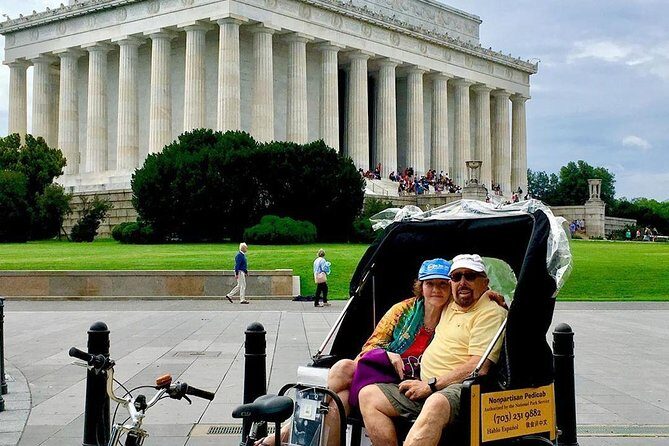
Washington DC’s National Mall is gorgeous, but it’s also a geometry test: long distances, flat sight lines, and crowds that swell when a tour bus unloads. This tour solves that by putting transportation and guiding together. You get a narrated route that connects the major landmarks people come for, while the pedicab handles the riding so you don’t chew up your energy too early.
The other big win is pace. This isn’t a rigid, line-queued “stand here for one minute” kind of day. You’ll be stopped often enough to take photos and learn something, but the vehicle means you’re not constantly re-starting your body from a dead stop. One review even calls out how this was a rare way to see DC without trying to get on and off buses or getting lost in the logistics.
You also get a “choose your level” approach. At several stops, you can simply look from outside, or you can go inside for views and photos if you’re up for it. That’s a practical balance for mixed groups: a parent who wants to rest can do that, while another person in your group can step in.
You can also read our reviews of more tours and experiences in Washington DC.



The itinerary flow: how the stops build a DC story
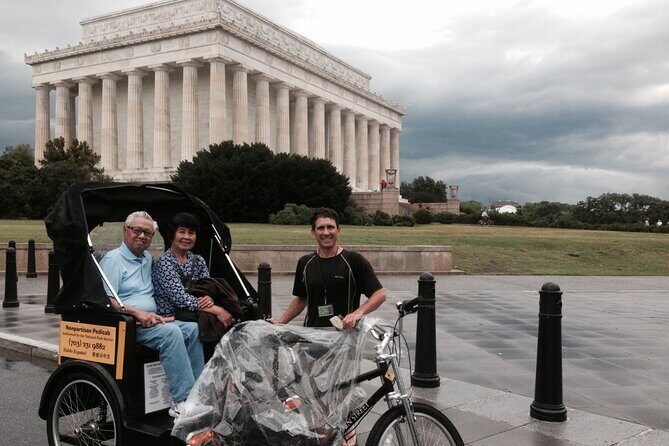
The route is built like a guided walk—just with pedicab power. You’re moving through the political heart of the city and then looping through the memorial language people remember: Lincoln, Jefferson, Martin Luther King Jr., FDR, and the war memorials around the Tidal Basin.
Timing is built around short narration blocks plus photo time and optional entry. That structure matters. If someone in your group has limited mobility, you’re not stuck “waiting for the group” as you’d be on a bus. If you’re traveling with kids, the frequent stops keep attention from wandering too far.
Below is what to expect at each stop, and what’s especially worth your time.
Stop 1: White House viewpoints and a fast history primer
Your first stop is the White House area, where you can see it from afar, up close, or both depending on what you’re doing that day. You’ll also get narration on the history of the White House and the notable men who lived there.
This is a smart opener. The White House is the symbol everyone knows, but most visitors don’t have a simple timeline in their head yet. A short guided explanation early on helps the rest of the monuments land harder—because you start understanding the city as a whole story, not a pile of marble.
Practical tip: treat this stop like your “photo warm-up.” Get the easiest shots first, then decide whether you want to linger on the details. With a pedicab, you’ll generally have less pressure to rush, but you still want a clean set of photos before you move on.
Stop 2: Washington Monument basics you can picture instantly
Next is the Washington Monument. You’ll get talk on what you’re looking at and its history—short and visual—so you can connect the monument’s design with the purpose behind it.
Why this stop works: the Washington Monument is one of those landmarks where people point and say “that’s the one.” But once someone explains the building logic and historical context, it stops being just a skyline element and becomes part of the nation’s early identity.
If you’re sensitive to sun or cold, this is a good moment to balance photos with shade. The tour’s weather protection helps, but you’ll still want to dress for the real conditions once you’re out at stops.
Stop 3: Lincoln Memorial—photo time plus optional inside viewing

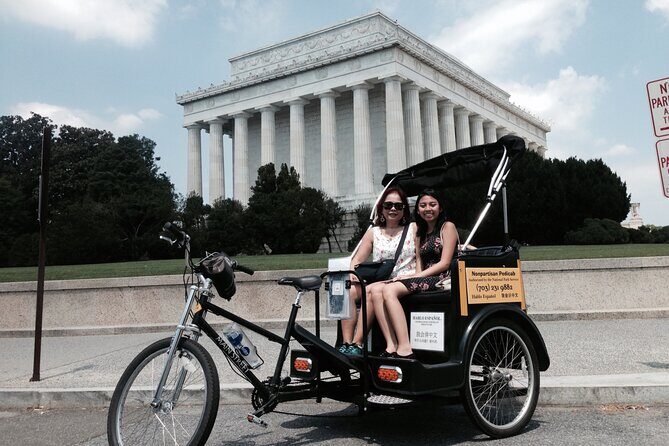
At the Lincoln Memorial, you’ll stop for photos and an in-depth narration that frames why people call it one of the most powerful monuments on the Mall. After that, you can go inside to explore, take photos, or admire the views.
This is one of the most important stops on the whole route because Lincoln Memorial is both symbolic and cinematic. Inside gives you a chance to slow down visually, not just from the outside edge.
Possible drawback to consider: if your group needs step-free access, it’s worth thinking ahead about how you’ll handle short transitions when entering any major memorial interior. This tour invites you to go inside, but the route is still a sightseeing day with some movement.






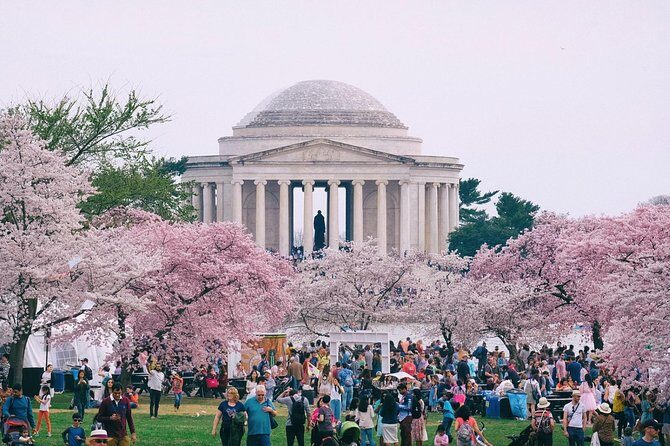
Stop 4: Jefferson Memorial—outside narration, inside views
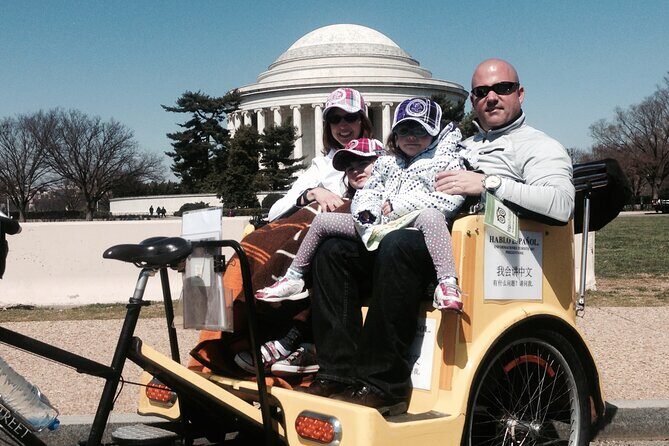
The Jefferson Memorial stop starts with narration outside, focused on Jefferson the man and the symbolic construction of the memorial. Then you’re invited to enter the memorial to admire the views and take photos.
This is the kind of stop that rewards attention. Jefferson-related monuments can feel like “name recognition” if nobody explains the symbolism. Here, you get the short version that makes the details click.
Practical tip: if you’re doing this with kids, the Jefferson Memorial is a great place to ask your guide a question. The tour format supports back-and-forth curiosity, and the guide’s job is to make history understandable without turning the day into a lecture.
Stop 5: Martin Luther King Jr. Memorial at the Tidal Basin

Next up is the Martin Luther King Jr. Memorial. You’ll get narration just outside, with a focus on the life and significance of MLK. Then you can go inside to see the statue and enjoy the views around the Tidal Basin.
This stop is special for two reasons. First, it’s emotionally powerful even when you only have a short amount of time. Second, the view element matters. The Tidal Basin setting makes your photos feel like part of the story, not random snapshots.
One of the reviews highlights how a guide handled hearing loss with extra care. That’s worth noting: you’re not just walking from plaque to plaque. The narration is the product, and the guides have a track record of adjusting.
Stop 6: FDR Memorial—right at the entrance, then explore
Your Franklin Delano Roosevelt Memorial stop is near the entrance, with a brief narration about Roosevelt and why the memorial’s symbolism matters. You’re then invited to enter on foot and explore.
This is a stop where “seeing” is different from “reading.” The guided talk gives you a map for what you’re looking at. Then you can wander at your pace inside.
If you’re traveling with mixed mobility needs, FDR is a good example of how the tour works with options. You’ll be offered both a guided starting point and the choice to go deeper where you can.
Stop 7: Korean War Veterans Memorial—up close after a look from afar
The Korean War Veterans Memorial has two phases: you first view it from afar, then you’re invited to see it up close.
That structure is handy. From afar, you get the overall layout. Up close, you can focus on the details that make the memorial feel human rather than abstract.
If you’re the type who likes taking a few “overview” photos at each site, this stop gives you both—without forcing you to choose one style.
Stop 8: Vietnam Veterans Memorial—walk through and absorb
At the Vietnam Veterans Memorial, there’s narration about the Vietnam War and why the memorial was constructed the way it was. You’re invited to walk through the memorial to appreciate it fully.
This is usually the stop where the day feels quiet, even if your group is chatty. The design invites reflection, and the walking through gives you time to experience the memorial rather than just pass it.
A practical note: this is another place where your pace matters. If someone needs fewer steps, it’s usually easier to plan a meet-up point than to try to “speed run” together.
Stop 9: U.S. Capitol—pass by the West Side
Finally, you’ll pass by the U.S. Capitol, the home of the legislative branch, and you’ll see it from the West Side.
This last stop functions like a closing beat. You’ve spent hours on monuments and memorials tied to the nation’s identity; ending at the Capitol helps tie the story back to the living institutions of the country.
If you want more Capitol photos later, you’ll have the morning/afternoon energy advantage from not doing a long walk. But within the tour, this is a focused glance that keeps you on time.
The guides: what their style adds to your day
A tour is only as good as the person steering it. This one has a strong reputation for personable guiding and real-world adjustments.
Names that show up in the experiences include Robert, Bob, Fahad, and Barry. People praised them for friendliness, strong city knowledge, and making the narration fit the group. One review mentions a guide using old photos before many monuments were built, which is a great trick: when you can compare the past to the present, the architecture stops being static.
Another review notes that the guide was accommodating with hearing loss, which tells me something important: you’re not just buying transportation. You’re buying a communication layer.
And yes, one family even mentioned seeing Marine One arrive, which is exactly the kind of DC surprise that can happen when you’re in the right location at the right time. You can’t promise that, but you’ll be in the areas where that sort of thing is possible.
Price and value: is $781 per group really fair?
The price is $781.00 per group (up to 2) for about 4 hours and 15 minutes. On its face, that’s not cheap.
Here’s how I’d judge the value. You’re paying for four things that are hard to replicate cheaply in DC:
- Private pacing: you’re not stuck with a group schedule that doesn’t match your energy.
- Transportation + guiding: you’re not just renting a ride. You’re getting narration and stop-by-stop structure.
- Multiple major sights: you’re covering the White House, key National Mall monuments, and the Capitol area in one sweep.
- Less physical cost: if you or someone in your group has limited mobility, the “save your legs” factor can be worth more than the ticket price. Several reviews specifically call out limited mobility as a reason the pedicab was the right choice.
Also, admission tickets at the stops listed here are free. That doesn’t mean you pay nothing overall, but it does mean you’re not facing a stack of attraction entry fees on top of the tour.
Is this worth it if you’re young, fast, and healthy and love long walks? Maybe not. But if your priorities are convenience, comfort, and an organized, close-up way to see the National Mall without the stress, the price makes more sense.
Who this tour suits best (and who might prefer something else)
This is an easy fit for:
- People with mobility impairments who want to see the big sights without long walks.
- Families with kids who need frequent breaks and a day that doesn’t turn into a marathon.
- Two-person trips where you want privacy and control without planning a complicated route.
- Dog owners since dogs are welcome.
It’s also a good match if you want history explained in a way that’s direct and timed to your eyes, not just read on a brochure.
Who might choose differently: if you’re determined to spend the entire day inside every memorial with zero time pressure and lots of reading, you may find the 4-hour format forces choices. This tour is built to see the highlights well, not to replace a day of wandering on your own.
Night tours: the lit-up version of the same route
This service also runs night tours, usually with the major sights lit up. Favorites at night mentioned include the White House, World War II, Lincoln, Jefferson, Roosevelt, and the Capitol.
Night changes the feel. The monuments can look more dramatic, and the atmosphere is often calmer than daytime crowds. If you’re someone who struggles with midday heat or bright sun, night can be more comfortable too.
If you’re booking and your schedule allows it, consider whether you want the daytime version (more direct daylight views) or the night version (more atmosphere). Either way, the tour format stays focused on close access and narration.
Practical details that affect your day
A few things matter more than people expect.
- Pickup is offered, and the tour can drop you off at almost any downtown location at the end. You can also be dropped off at the starting location. That reduces hassle when you’re juggling taxis, ride shares, or parking.
- Mobile tickets are used, which usually means less time digging around for paper.
- Most travelers can participate, and service animals are allowed.
- You’ll start and finish at 1401 Pennsylvania Avenue NW, Washington, DC 20004.
Also, the tour runs daily from 9:00 AM to 9:00 PM during the listed operating season (03/24/2025–06/16/2026). That gives you options if you’re trying to work around other DC plans.
One more thing: the experience requires good weather. If it’s canceled for poor weather, you’ll be offered a different date or a full refund. In DC, that’s a big deal because plans can change fast.
Should you book the Grand Monuments & Memorials Tour?
Book it if you want the most effective way to cover DC’s core monuments without turning the day into a physical challenge. This tour shines for mixed-mobility groups, families with kids, and anyone who wants a guided explanation while still keeping control of how long you linger at each stop.
Skip it only if you’re looking for a self-guided, do-it-all-day-on-foot experience and you don’t care about close access or guided narration. If you want your DC day to be organized, comfortable, and built around your pace, this route is a strong bet—especially given the private setup and the guides’ ability to adapt to real needs.