REVIEW · TOUR REVIEWS
We the People Tour: The Essence of Liberty
Book on Viator →Operated by LIBERTY TOURS DC · Bookable on Viator
Liberty has a map in DC. This We the People Tour: The Essence of Liberty strings together the places where U.S. ideals are written, enforced, tested, and remembered.
I love the way the route moves you through big DC icons in a tight time window, and I love that the guide experience can turn quick stops into moments that actually land. People often highlight guides like Brian McCauley and Danny for energy, humor, and thoughtful help, including respectful time at the Vietnam Memorial.
One thing to plan for: the pace is brisk, with about 15 minutes at most outdoor stops, so you’ll see a lot but won’t have a long sit-down at every monument.
In This Review
- Key highlights you’ll feel right away
- A 4-Hour Route That Makes Liberty Concrete
- Meeting Point, End Location, and the Pace You Should Expect
- Capitol Hill: United States Capitol in a Short, High-Impact Stop
- The White House: Why One Building Represents a System
- World War II, Korea, Vietnam: War Memorials That Don’t Feel Like “Just Photos”
- National World War II Memorial
- Korean War Veterans Memorial
- Vietnam Veterans Memorial
- Jefferson and Martin Luther King Jr.: Founding Ideas and Civil Rights in One Flow
- Jefferson Memorial
- Martin Luther King Jr. Memorial
- Lincoln Memorial and Vietnam: Where Symbolism Meets Reality
- National Archives Museum: The Document Side of Liberty
- Guide Energy: What Makes This Tour Feel Like More Than Stops
- Value for Money When So Much Is Free
- Who Should Book This Tour, and Who Might Want Something Else
- Should You Book We the People Tour: The Essence of Liberty?
- FAQ
- How long is the We the People Tour: The Essence of Liberty?
- What time does the tour start?
- Where do I meet for the tour?
- What language is the tour offered in?
- Is admission included for all stops?
- Do I need a printed ticket?
- What is the maximum group size?
- Are service animals allowed?
- Does the tour require good weather?
- Is there an option that includes extra time at a preferred location?
Key highlights you’ll feel right away

- A smart DC loop that links government power with memorials on the National Mall
- Most stops are free, so your money goes to the experience, not extra entry lines
- Guide-led details that help you notice what you’d miss on your own
- Real time for the hardest stories, especially at the Vietnam Veterans Memorial
- National Archives Museum included, with access to the documents behind key U.S. decisions
- Small-group feel within a cap of 56, which helps the tour stay organized
A 4-Hour Route That Makes Liberty Concrete
This tour is built for first-time DC visitors and for anyone who feels overwhelmed by the sheer number of monuments. The format is simple: hit major landmarks along the National Mall and then connect the dots between founding ideals and the people who fought to live them out.
The tour clocks in at about 4 hours, starting at 10:00 am. That time matters because DC outdoors can eat up hours fast—transit, crowds, and the temptation to linger. Here, you get a plan, plus a guide to keep you from drifting into the “I saw things, but what did it mean?” zone.
You can also read our reviews of more tours and experiences in Washington DC.



Meeting Point, End Location, and the Pace You Should Expect
You’ll meet at 701 15th St NW, Washington, DC 20005. From there, the tour runs as a guided walk-and-stop loop, with the day structured around short, focused visits.
Most stops are timed at about 15 minutes each. The exception is the National Archives Museum, which gets about 1 hour 30 minutes. In other words, you’ll be moving most of the time, with a longer indoor window where documents take center stage.
Also note: the activity ends in a different location. That’s not a problem, but it does mean you should plan how you’ll get back to your plans. If you prefer to stay in the same neighborhood after the tour, keep your route options in mind before you buy anything.
Capitol Hill: United States Capitol in a Short, High-Impact Stop
The day starts at the United States Capitol, the home of the U.S. Congress and the seat of the legislative branch. Even in a quick visit, this stop gives you an instant sense of scale and authority—because you’re standing at the physical heart of how laws get made.
You also learn the Capitol’s role in DC’s layout: it forms the origin point for the District’s street-numbering system and its quadrants. That’s a small detail, but it helps you “read” the city instead of just photographing it.
Admission here is free with a ticket. You won’t spend long, but the payoff is orientation: you’ll understand where the rest of your day fits in the broader government picture.
The White House: Why One Building Represents a System

Next is the White House, the official residence and workplace of the president. You’ll likely hear the term White House used as shorthand for the president and advisers, and this stop makes that idea feel real fast.
The timing is about 15 minutes, which is ideal if you want to see the landmark without losing the day to crowd waits. The benefit of the quick stop is that it keeps the tour momentum. You move from lawmaking (Capitol Hill) to executive power (the White House) without a big gap.
One practical tip: plan for wind and weather here. The White House area can feel open and exposed, and short visits mean you don’t get a long break—dress like you’re going to stand outside for a bit.
World War II, Korea, Vietnam: War Memorials That Don’t Feel Like “Just Photos”
Then the tour shifts into a powerful sequence of memorials, each with its own design language and purpose. The National Mall is famous for icons, but these stops do something different: they slow you down emotionally, even when the clock keeps moving.






National World War II Memorial
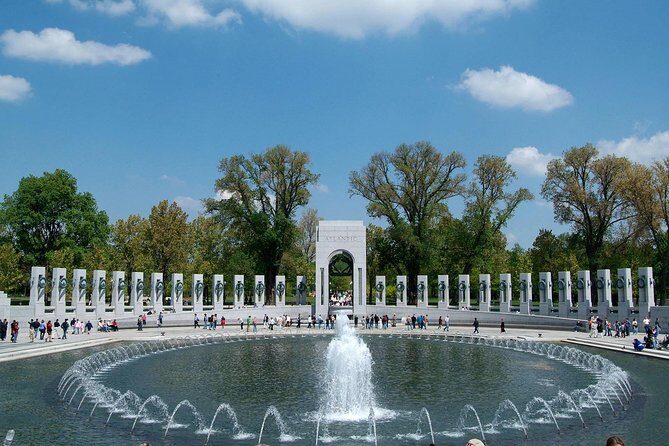
The World War II Memorial is dedicated to Americans who served in the armed forces and as civilians during World War II. It features 56 pillars and two small triumphal arches around a square and fountain.
In a short stop, what you’re really trying to do is find the memorial’s structure—pillars, arches, and the central space. Once you see the geometry, the place stops being a backdrop and turns into a layout for remembrance.
Korean War Veterans Memorial
The Korean War Veterans Memorial is also on the National Mall area, in West Potomac Park. It memorializes those who served in the Korean War. This is one of the stops where admission is included.
In a tight itinerary, this stop is valuable because it adds an “in-between” conflict that sometimes gets overshadowed. You get continuity across wars, not just a greatest-hits tour.
Vietnam Veterans Memorial
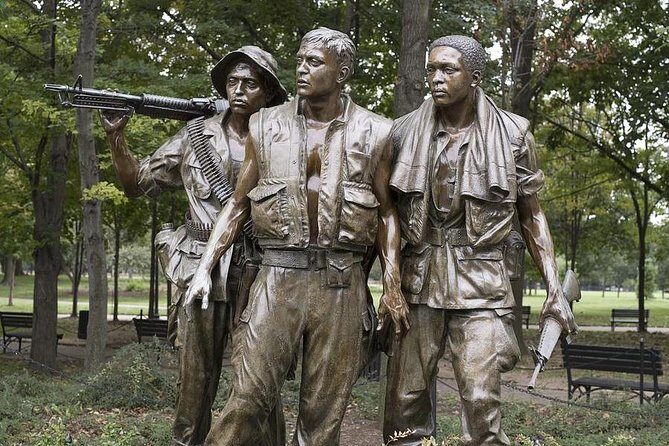
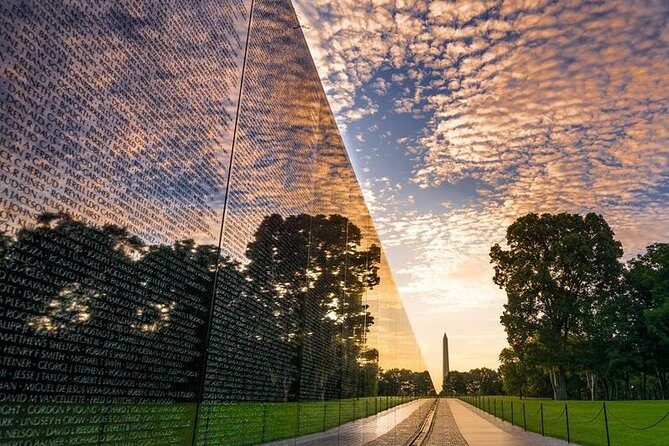
The Vietnam Veterans Memorial is the emotional center of this kind of tour. It’s a 2-acre site and honors service members who fought in the Vietnam War, those who died, those unaccounted for, and more.
You get three connected parts:
- the Vietnam Veterans Memorial Wall
- The Three Soldiers
- the Vietnam Women’s Memorial
Even if your time is only about 15 minutes, this stop is where a guide’s tone matters. One reason this tour earns strong marks is the way guides handle respectful moments. If you want to bring a name to the Wall, this is the stop where you should slow down your eyes and do it intentionally.
Jefferson and Martin Luther King Jr.: Founding Ideas and Civil Rights in One Flow

After the war memorials, the route turns toward civil liberties and the people who pushed them forward.
Jefferson Memorial
The Jefferson Memorial is dedicated to Thomas Jefferson, main drafter and writer of the Declaration of Independence, among many other roles. A guide can quickly connect Jefferson’s ideas to the physical monument, but the most useful part is how the stop broadens your understanding of “founder” beyond one famous document.
You’ll learn that Jefferson wasn’t only a statesman—he was also the founder of the University of Virginia. That matters because it shows a theme: liberty isn’t just politics. It’s institutions, education, and long-term nation-building.
Martin Luther King Jr. Memorial
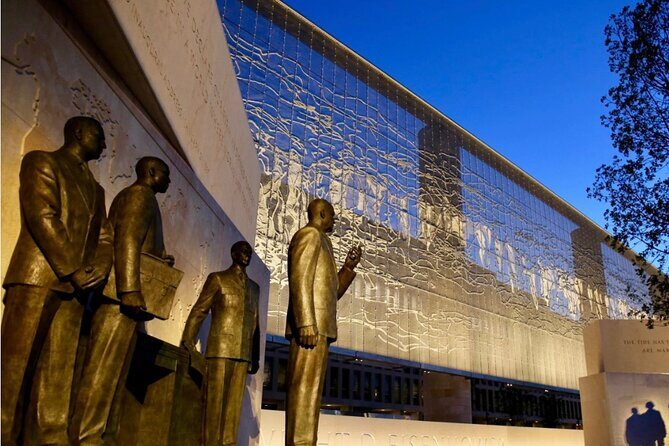
The Martin Luther King Jr. Memorial covers four acres and includes the Stone of Hope, a granite statue created by sculptor Lei Yixin. The design is inspired by the line from King’s I Have a Dream speech: out of the mountain of despair, a stone of hope.
In a short stop, the goal is to notice the symbolism. This memorial isn’t trying to be neutral. It’s trying to make you think about hope as a force you can build, not a slogan.
Lincoln Memorial and Vietnam: Where Symbolism Meets Reality
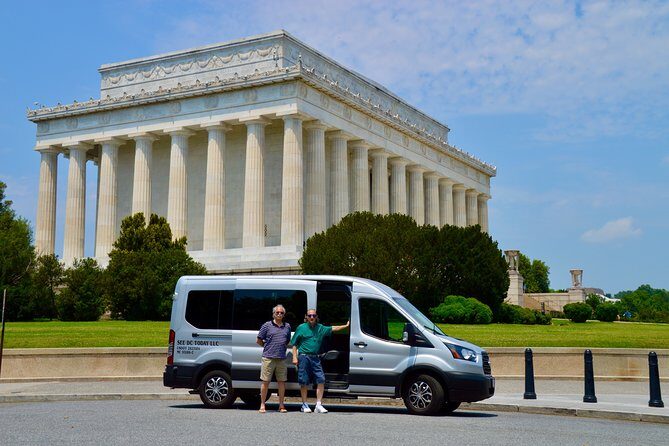
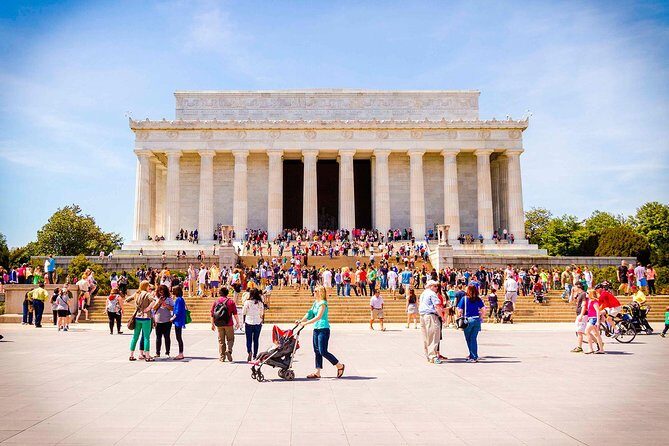
The Lincoln Memorial anchors the western end of the National Mall, across from the Washington Monument. It’s built to honor Abraham Lincoln, and you get context on the architects and design choices, including Henry Bacon and the main Lincoln statue created by Daniel Chester French.
What’s especially useful here is how the memorial is tied to race relations. Since the 1930s, it’s been a symbolic center for that national conversation. So when you see Lincoln here, you’re not just seeing a statue. You’re seeing a meeting point of memory, conflict, and change.
Then, right back into the Vietnam Veterans Memorial, which is where the tour asks you to face the human cost. In places like this, a guided stop can help you avoid the common mistake of treating memorials like checkpoints on a list. You can still keep the pace, but you’ll be more deliberate about what you’re looking at.
National Archives Museum: The Document Side of Liberty

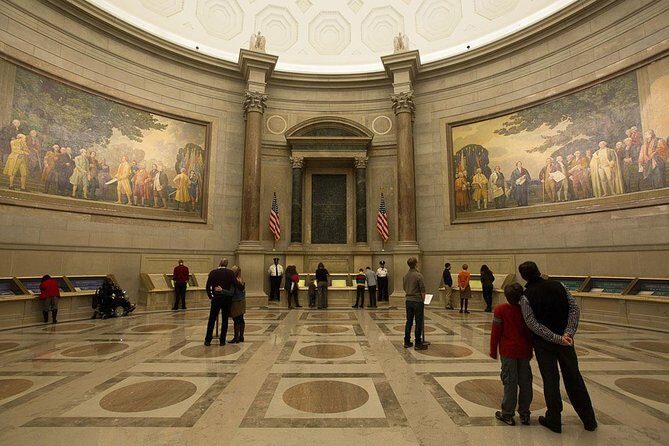
The final major stop is the National Archives Museum. This is the biggest time block on the tour at about 1 hour 30 minutes, and it changes the feel of the day.
Here, the focus is on the National Archives and Records Administration (NARA), the agency responsible for preserving and documenting government records. The key is what the museum protects: legally authentic and authoritative copies of acts of Congress, presidential directives, and federal regulations.
The tour also connects you to a less-famous but important function: NARA transmits Electoral College votes to Congress. This detail helps you understand that “democracy” is not only speeches and monuments. It’s paperwork, processes, and proof.
Admission here is included, which is a real value advantage. Instead of juggling separate museum tickets, you’re getting a structured visit built into the itinerary.
Guide Energy: What Makes This Tour Feel Like More Than Stops
The most consistently praised element is the guide experience. Multiple comments single out Brian McCauley and Danny for going above and beyond—being fun, making the day feel lighter even when it’s raining, and giving the kind of attention that turns landmark touring into guided meaning.
One of the most practical parts of having a strong guide shows up at the Vietnam Memorial. People talk about help with an etching of a childhood friend’s name and the way the guide took the moment seriously. That’s exactly the sort of thing you’d never figure out alone, and it’s the difference between seeing the memorial and actually participating in it.
Another theme is accommodation for different ages. One review highlights front-door ease for elderly parents. While you still need to handle your own comfort and mobility, the tour’s pacing and “make it easy” approach can matter a lot if your group includes someone who tires quickly.
Value for Money When So Much Is Free
This is where the tour earns its keep. Many stops are free with admission tickets, including the Capitol, White House, WWII Memorial, Jefferson Memorial, MLK Memorial, Lincoln Memorial, and Vietnam Veterans Memorial.
Only a couple of stops list admission as included in the experience you book: the Korean War Veterans Memorial and the National Archives Museum. Translation: you’re not paying to enter the biggest landmarks you came to see, and your included admission time is focused on places that reward attention.
Add in the fact that the tour uses a mobile ticket, and you get fewer hassles on the day. A mobile ticket doesn’t change the sights, but it does reduce friction when you’re moving fast.
And yes, group discounts are listed. Even without knowing the exact savings, that signals the company is built for cost-effective touring in a shared format.
Who Should Book This Tour, and Who Might Want Something Else
This tour is a strong pick if you want:
- a first look at Washington DC’s most iconic civic sites and memorials
- a route with a plan so you don’t spend half the day guessing
- a guide who helps you understand what you’re seeing in plain language
- a good balance of indoor and outdoor time, with National Archives getting the longer slot
It may be less ideal if you want:
- lots of quiet time at each monument without a schedule
- slow museum-style wandering at every stop
- a tour that ends right where you want to keep exploring without extra travel planning
Should You Book We the People Tour: The Essence of Liberty?
If your goal is to see the big meaning of DC—not just the big landmarks—this is a smart way to do it. The mix of government symbols (Capitol and White House) with war and civil rights memorials gives you a fuller picture of liberty as an ongoing project, not a finished slogan.
Book it if you like structure, short guided stops, and one longer indoor finale at the National Archives Museum. Skip it if you hate time limits or you need to linger deeply at every single monument.
Either way, pack for weather, wear shoes you can trust for repeated short walks, and keep your phone charged so the mobile ticket and navigation stay easy.
FAQ
How long is the We the People Tour: The Essence of Liberty?
It runs for approximately 4 hours.
What time does the tour start?
The start time is listed as 10:00 am.
Where do I meet for the tour?
The meeting point is 701 15th St NW, Washington, DC 20005, USA.
What language is the tour offered in?
The tour is offered in English.
Is admission included for all stops?
Not all stops are included. The Korean War Veterans Memorial and the National Archives Museum list admission as included, while several other major stops list admission as free.
Do I need a printed ticket?
No. It uses a mobile ticket.
What is the maximum group size?
The tour has a maximum of 56 travelers.
Are service animals allowed?
Yes, service animals are allowed.
Does the tour require good weather?
Yes. The experience requires good weather, and if it’s canceled due to poor weather you’ll be offered a different date or a full refund.
Is there an option that includes extra time at a preferred location?
Yes. Choosing option 2 gives extra time at the location you prefer, but you would need to provide your own transportation back to your hotel.