REVIEW · CAPITOL & LIBRARY OF CONGRESS
U.S. Capitol and Library of Congress Tour with Rotunda & Crypts
Book on Viator →Operated by Signature Tours of DC · Bookable on Viator
Big Washington symbols deserve a guided path. This tour bundles U.S. Capitol access with a guided circuit through the Rotunda and Crypt, then carries you into the Library of Congress for the Jefferson Building’s standout rooms, including the famous Gutenberg Bible. The value is in the flow: security is handled, you get headsets inside, and your guide adds context so you notice details you’d otherwise miss.
Two things I like a lot: the Capitol stop focuses on the high-impact visuals like The Apotheosis of Washington (about 180 feet overhead) and the Crypt that was originally intended for Washington’s burial, and the Library time is spent in the right order so you reach the icons fast, from the Gutenberg Bible to the main reading room. The main drawback to consider is that government closures can shut parts of the experience down with little notice, so plan with some flexibility.
In This Review
- Key Highlights Worth Clearing Your Schedule For
- Why This Capitol + Library Combo Makes Sense
- The Start Near the U.S. Botanic Garden Conservatory
- The Capitol Hill Walk: Quick Passes, Big Context
- Entering the U.S. Capitol: Security, Film, Headsets
- Rotunda and Crypt: What to Notice Right Away
- National Statuary Hall and the Possibility of Old Chambers
- Library of Congress Jefferson Building: Timed Entry That Feels Like Magic
- What You Learn in the Reading Room (and Why It Matters)
- Supreme Court, Grant, and the “Outside-Only” Stops
- Price and Value: $56 Isn’t Just for Entry
- Who This Tour Is Best For
- Should You Book This U.S. Capitol and Library Tour?
- FAQ
- How long is the tour?
- What’s included with admission for the U.S. Capitol?
- Is admission to the Library of Congress included?
- Do I get to see the Gutenberg Bible?
- What Capitol rooms will I likely see?
- Is the Supreme Court stop included with admission?
- What should I wear for this tour?
- What if the Capitol or Library is closed on my date?
Key Highlights Worth Clearing Your Schedule For

- Rotunda ceiling drama: You get The Apotheosis of Washington framed in context, not just as a postcard.
- Crypt with real purpose: It’s tied to Washington’s burial plans, which makes the space feel heavier.
- Gutenberg Bible priority: You’re brought to see the Gutenberg Bible, including the fact it’s one of only 3 perfect vellum copies.
- Jefferson Building wow-factor rooms: Great Hall + Main Reading Room are timed so you don’t waste time wandering.
- Architectural nerdy wins: Electric-light planning and early climate-control design get real-world explanation.
- A reliable swap if the Library is shut: When the Library can’t be visited on your day, you’ll visit the Capitol Museum instead.
Why This Capitol + Library Combo Makes Sense
Washington, DC can be overwhelming when you’re trying to hit the big-ticket places. What makes this tour work is that it attacks the hardest parts of planning for you: security entry into the Capitol and timed-entry access into the Library of Congress.
Also, you’re not just looking at buildings. You’re walking through the ideas those buildings represent. The Capitol is where you see the visual language of power and symbolism, and the Library of Congress is where that symbolism turns into craft: marble, mosaics, carvings, and the reading rooms people recognize from movies.
Finally, the small-group setup (up to 40 people) matters. In a place like this, you need momentum. This tour is built for getting you inside key spaces without turning the day into a long wait-and-stand marathon.
You can also read our reviews of more tours and experiences in Washington DC.



The Start Near the U.S. Botanic Garden Conservatory

You meet at 101 Independence Ave SE, but the practical start point is right across the street from the U.S. Botanic Garden Conservatory at 100 Maryland Avenue SW. If you like arriving early and getting your bearings, this is a good setup. The Botanic Garden area is easy to orient to, and it gives your walk a clean beginning.
From there, you’ll start seeing Capitol Hill the way locals experience it: not from a bus window, but by passing key landmarks on foot. The outdoor part isn’t random sightseeing. It’s there to set the stage before you step into the most formal rooms in DC.
And you get some memorable “stop-the-walk” moments:
- A massive equestrian statue, notable for how long it took to complete (about 20 years).
- Peace Monument / Peace Circle, which commemorates naval deaths from the Civil War, with sculpted figures labeled Grief and History.
This kind of pre-context is useful. By the time you reach the Capitol steps, you’re already primed to connect what you saw outside to the political and commemorative themes inside.
The Capitol Hill Walk: Quick Passes, Big Context

Before you go fully inside, you’ll pass by several major landmarks tied to national government. Expect stops and viewpoints around the Supreme Court, the Senate Offices, and the House of Representatives area, plus the Ulysses S. Grant Memorial and the Peace Circle.
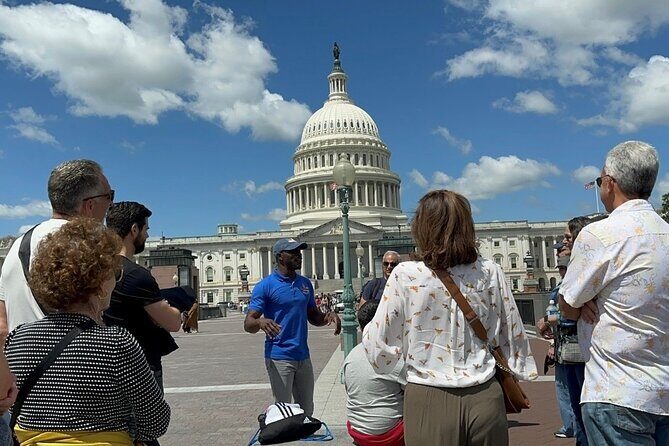
Then there’s a guided walking block on Capitol Hill (the tour is scheduled for about a two-hour morning or afternoon walk, depending on your option). This matters because Capitol Hill is compact but visually complicated. Even if you know the names, it’s hard to understand how the spaces relate until someone points out what you’re looking at.
One practical note: this portion includes standing and walking, and it’s outdoors. DC weather can swing hard, so you’ll want comfortable shoes and layers you can adjust fast.
Entering the U.S. Capitol: Security, Film, Headsets

The Capitol portion is where the tour becomes “not just entry.” You go through security, then there’s a short break and an orientation film. After that, you join the official guided tour using headsets.
Here’s the key detail: your tour guide handles the overall experience and adds explanation around what you’re seeing, but the guided content inside the Capitol is shared with the official headset tour format. That’s normal in this building, and it’s often why packaged tours feel smoother than DIY attempts.
The official route typically includes:
- Crypt
- Rotunda
- National Statuary Hall
Depending on the day, you might also be able to access older spaces like the Old Supreme Court or Old Senate Chambers. That “sometimes” part is important. Don’t build your whole expectation around those rooms, but it’s a nice bonus if your day works out.
Also, keep in mind that the U.S. government can close or cancel Capitol interior tours without advance notice. If this trip is tied to a specific date that can’t flex, it’s worth factoring that risk into your plan.
Rotunda and Crypt: What to Notice Right Away

The Rotunda is the headline for a reason, but it’s more fun when you know what you’re looking at.
In this tour, you’ll be pointed toward The Apotheosis of Washington. It’s painted roughly 180 feet above the floor, so you’ll need to look up and let the scale hit you. The guide context helps you understand why Washington’s image and the artwork’s placement matter, not just that it’s impressive.
Then you go to the Crypt. This area carries a real sense of intention. It was originally planned as the burial site for Washington. That detail changes how the space feels. Instead of just being a cool underground stop, it becomes part of the story of how the country imagined its future.
If you only have time to “skim” one interior segment of the Capitol, I’d prioritize the Rotunda-Crypt pairing. This tour is set up so you experience them as a connected arc, not separate boxes on a checklist.






National Statuary Hall and the Possibility of Old Chambers

National Statuary Hall is where you start noticing the Capitol as a living museum of memory. You’ll see statues representing states, and the guided format helps you make sense of why these symbols are placed where they are.
On some days, the route may also include the Old Supreme Court or Old Senate Chambers. Those spaces can be especially meaningful because they feel like stepping into older DC government rhythms. When you do get access, you’ll often appreciate it more than you expect, since these are the kinds of rooms that aren’t guaranteed.
This is one reason I like choosing a guided tour even if you’re comfortable reading on your own. The Capitol’s layout can confuse your first-timer brain. A guide helps you avoid wandering into dead ends or spending time where the “wow” factor isn’t actually happening.
Library of Congress Jefferson Building: Timed Entry That Feels Like Magic
After the Capitol, the tour moves to the Library of Congress. Here’s how it’s built for speed and payoff:
- You’re escorted to a tunnel.
- Then you use timed-entry passes.
- You walk into the Jefferson Building in a way that keeps you from losing your entire visit to lines.
The Jefferson Building is widely considered the standout architecture of the Library, and this tour gets you inside quickly enough that you can actually enjoy the spaces rather than race through them.
The high points you’ll focus on include:
- The Gutenberg Bible: the tour specifically highlights that it’s one of only 3 perfect vellum copies in existence.
- The Great Hall: an Italian Renaissance-style atrium with marble columns, mosaics, gold leaf, and murals.
- The Main Reading Room: the circular reading room you’ve probably seen in films.
There are also small details worth paying attention to once you’re standing there: putti and carvings along the balustrades, with cherubic figures representing arts and sciences. Those bits are easy to miss when you’re rushing.
What You Learn in the Reading Room (and Why It Matters)

The Main Reading Room is iconic, but it’s the explanation that turns it from a photo backdrop into a real place. You’ll also hear the story behind the Jefferson Building’s design choices, including early planning for electric lighting and the use of a strong climate-control system.
Those design points are more than trivia. They help you understand how the Library protects fragile materials and why architecture was treated as a practical tool for preservation, not just decoration.
You’ll also see references to Thomas Jefferson’s original library as part of what’s included in the Library experience. It’s the kind of touch that makes the Library feel connected to the country’s founding ideas, not just to the present-day building.
One more practical thing: the Library stop is short (about 20 minutes on the schedule). That means it’s best for people who want the highlights efficiently. If you love slow museum-style wandering, you might still want a separate longer visit later.
Supreme Court, Grant, and the “Outside-Only” Stops
You’ll pass the Supreme Court building, but that segment is outside-only and does not include admission. The same approach applies to other Capitol Hill landmarks you’ll see while walking.
That’s actually a benefit for most people. The tour doesn’t waste time trying to squeeze in places that need separate security and separate entry procedures. You get the big exterior context for the judiciary and executive branches, then you focus your time where you can actually go inside: the Capitol and the Library.
Price and Value: $56 Isn’t Just for Entry
This tour costs $56 per person, and the value comes from the structure.
Yes, you could potentially plan parts of DC yourself. But packaged tours save the two things that derail first-time visits:
- coordinating timed entry into hard-to-book spaces
- managing the security and flow once you get there
Here’s the balanced way to think about it. If your goal is only to see the buildings with minimal commentary, DIY can feel cheaper. If you want a guide to connect symbolism, artwork placement, and architectural choices into something you actually remember, then the extra cost starts to make sense.
The guides named in feedback—people like Dwayne and Tyrone, plus Rochelle—show up repeatedly in how this experience gets described. The most consistent theme is that guides help keep the day organized and explain the tricky or easy-to-miss details.
One caution: since the Capitol’s official headset tour is part of the experience, you’re not getting total control over every second inside. If you expect a private, uninterrupted narration in every room, adjust your expectations. What you’re buying is guided framing and a smoother visit, not a one-on-one classroom lecture.
Who This Tour Is Best For
I’d point this tour toward:
- first-time DC visitors who want the big two hits (Capitol and Library) without a full-day planning headache
- people who like learning while they walk, especially when the guide can explain what you’re seeing
- couples and families who want a guided plan but still have time for your own add-ons later
It’s also a good fit if you like momentum and don’t want to lose hours waiting around.
I’d think twice if:
- you want a long, slow Library of Congress experience. The visit here is focused and time-limited.
- you hate any chance of schedule disruption. Government closures can affect Capitol interior access.
- you’re hoping to avoid outdoor walking entirely. This includes standing and walking outdoors before and between interior stops.
Should You Book This U.S. Capitol and Library Tour?
If you want the fastest path to the most famous rooms, this is a strong choice. You’ll get a guided Capitol circuit that prioritizes the Rotunda and Crypt, plus a timed-entry Library experience that targets the Gutenberg Bible, the Great Hall, and the Main Reading Room.
My decision rule is simple:
- Book it if you want guided context + efficient access in about a couple hours.
- Consider DIY or a separate longer Library visit if you only care about entry and photos, or if your schedule can’t absorb the chance of an interior closure.
If you do book, I’d also plan around the Library hours. The Library of Congress visit can swap to the Capitol Museum when the Library is closed (like Mondays or at 8am), so check your day before you fall in love with one specific room.
FAQ
How long is the tour?
The tour runs for about 2 hours (approx.). The U.S. Capitol portion is about 1 hour 30 minutes with admission included, and the Library of Congress highlights are about 20 minutes.
What’s included with admission for the U.S. Capitol?
You’ll have admission to the U.S. Capitol building with a guided tour format using headsets after security and an orientation film. The typical rooms include the Crypt, Rotunda, and National Statuary Hall.
Is admission to the Library of Congress included?
Yes. Admission to the Library of Congress is included with timed-entry passes, and you’ll visit the Jefferson Building. If the Library is closed (Mondays or at 8am), the experience includes the Capitol Museum instead.
Do I get to see the Gutenberg Bible?
Yes. The tour includes seeing the Gutenberg Bible at the Library of Congress, noted as one of only 3 perfect vellum copies in existence.
What Capitol rooms will I likely see?
You should expect the Crypt, Rotunda, and National Statuary Hall. Depending on the day, you may also get access to the Old Supreme Court or Old Senate Chambers.
Is the Supreme Court stop included with admission?
No. You’ll pass by the Supreme Court building, but admission is not included for that stop.
What should I wear for this tour?
Wear comfortable shoes. There will be standing and walking, and much of the tour is outdoors, so dress for the weather and bring layers. Umbrellas can help depending on the season.
What if the Capitol or Library is closed on my date?
Tours inside the U.S. Capitol can be closed or canceled without advanced notice. Also, the Library of Congress can be closed on certain days or times, in which case the tour includes the Capitol Museum instead.